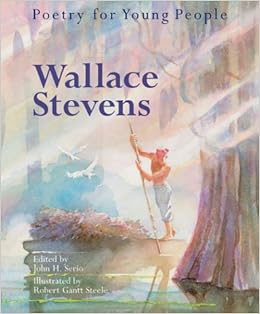
Wallace Stevens
Edited by John N. Serio
Illustrator: Robert Gantt Steele
Publishing Company: Sterling Publishing
Co.
Copyright Date: 2004
52 pages
Poetry
Collection
 I
originally checked this book out just solely based on the few pages I saw while
flipping through in the library. Based on this I had the assumption that this
book was a collection of poems from different authors. When I actually sat down
to read through it, I realized that it was instead a collection of poems by Wallace
Stevens as indicated by the title. Due to the misconception I had of this book,
I was even more interested in reading it. Each of Wallace Stevens poems in this
collection vary in style. But most all of his works had one thing in common,
nature. The introductory section in this book explains that this has always
been a very large part of Wallace Stevens’ life, and this is seen throughout his
work.
I
originally checked this book out just solely based on the few pages I saw while
flipping through in the library. Based on this I had the assumption that this
book was a collection of poems from different authors. When I actually sat down
to read through it, I realized that it was instead a collection of poems by Wallace
Stevens as indicated by the title. Due to the misconception I had of this book,
I was even more interested in reading it. Each of Wallace Stevens poems in this
collection vary in style. But most all of his works had one thing in common,
nature. The introductory section in this book explains that this has always
been a very large part of Wallace Stevens’ life, and this is seen throughout his
work.
Steele’s illustrations
throughout the book are done with watercolor. The placement of the
illustrations are based on the length of each poem. The majority of these illustrations
covered a single page and very few double spread illustrations were seen
throughout this collection. I felt that the illustrations played a huge role in
bringing meaning to his poems. The text is set up as most all poetry
collections are. Each poem starts its own page as each poem in this book tells
its own story. The majority of the poems were only one page, and very few
covered two.
One aspect I really liked
about this collection of poems is that an interpretation of each poem was included at the top of each page.
I think this is an excellent way for children to read and understand poetry. Therefore this is one of
the first ways I would incorporate this book into my classroom. Ideally I would
have students first read a poem from this collection on their own and create an
interpretation of what they think the author was trying to express in his writing.
After they have written their own interpretations, I would have the students
read what interpretations were included in the book. They would then share
aloud the similarities and differences between these interpretations. The
second way I would incorporate this book into my classroom would be within a
poetry unit. This book has a wide variety of poems and I feel that my students
would benefit from these different examples in their instruction. The third way
I would use this book in my classroom would be in a senses unit. Steele’s
poetry is absolutely full of different examples the students could find. I feel
that they would love to make this connection to text. As you can see, this book
is full of great teaching opportunities. I would definitely use this book in my
classroom.

No comments:
Post a Comment